Art Van Go the Studios

  home | shop | gallery | workshops | techniques | out & about |  about us  

ART VAN GO
the studios
1 stevenage road
knebworth
hertfordshire sg3 6an

tel: +44 (0)1438 814946
fax: +44 (0)1438 816267
how to get to the studios

Procion Dyes and Dyeing

PROCION DYES: Fibre-reactive dyes for natural fabrics. In powder form. Particularly
effective on cellulose based fibres (eg cotton, linen, viscose); they may be lighter and less predictable on wool and silk. Bright, clean, permanent colours. Colours are intermixable, or one colour can be dyed over another.
Procion dyes are considered non-toxic when used properly, though the use of a face mask and rubber gloves is highly recommended to avoid the inhalation of powder and the prolongued contact with dye solution.

Procion Auxiliaries

UREA
hygroscopic agent to keep moisture in the fibres which is necessary for the setting process. Not necessary for bucket-dye method.
CALGON
neutralises the metallic salts of tap-water. Particularly necessary in hard water
areas, though worth using everywhere to increase the dye uptake. Available easily and cheaply from the supermarket.
SODA ASH, WASHING SODA or BICARB
causes a chemical reaction in the presence of heat and moisture to fix the dye. Washing soda and bicarb are available from the supermarket.
METAPEX or SYNTHRAPOL
detergent which prevents colour contamination during the rinse process by consolidating the remaining dye so that it will not set into other areas while rinsing. Also can be used to scour the fabric prior to dyeing instead of standard detergents.
MANUTEX or SODIUM ALGINATE
a thickening agent to convert Procions into a paste for direct painting, screen- or block-printing. In powder form.
SUPERCLEAR
a thickener based on tannins, available already made up in a jar.

The recipes shown below are produced with simplicity in mind rather than critical measurements for colour matching. Keep records of quantities and proportions if colours have to be reproduced.

Basic recipe for bucket-dyeing

Work on the basis of about 5gms (roughly one teaspoon) of dyepowder for strong colour on 100gms dry fabric. Use proportionally less powder for lighter shades.

  • Weigh dry fabric and then wash to remove fabric dressing, dirt or grease.
  • Fill a container with enough hot water to comfortably cover the fabric and allow for movement through stirring eg 3 gallons of water in a 5 gallon bucket.
  • For every 3 gallons of water add about 400gms ordinary salt. Add the dye powder.
  • When both completely dissolved, add wet fabric and stir for 20mins.
  • In separate container dissolve 100-200gms soda ash/washing soda for every 3 galls of water in dye bath.
  • When completely dissolved add to the dyebath one-third at a time at 5 min intervals, stirring as you add it. DO NOT POUR DIRECTLY ONTO FABRIC.
  • Continue stirring every 5mins over the next 50mins for strong colours. Reduce this time if you require lighter shades.
  • Remove from dyebath and rinse in cold water until clear. Finally wash in hot water with detergent or Synthrapol. Rinse and dry.

For dyeing in a washing machine, please ask for leaflet

Basic recipes for painting directly onto the fabric

In advance, make up a 1litre bottle of Chemical Water, and a 1litre bottle of Washing Soda Water (recipes below). These can be kept more or less indefinitely, ready for when you need them for making up small quantities of dye for painting.

  • CHEMICAL WATER RECIPE
    Dissolve 36tsps (about 180-200gms) UREA, and 1tsp CALGON in 1Litre warm water.
  • WASHING SODA/SODA ASH WATER
    Dissolve 500gms Washing Soda
    OR
    200gms Soda Ash
    into 1Litre hot water.

To make up dye for painting directly as a free flowing colour

NB. Although the elements will keep indefinitely if stored separately, once brought together they will only be viable for a few hours. Only make up as much as needed each time.

  • Dissolve a small amount of powder in a palette (about a quarter of a teaspoon - although this can vary depending on strength of colour desired) with a little warm water.
  • Add the CHEMICAL WATER and WASHING SODA (or SODA ASH) to the palette roughly in the ratio of 60:40, although this usually degenerates into a slosh of the first and a splash of the second. This then makes your 'ink' to paint onto your fabric.
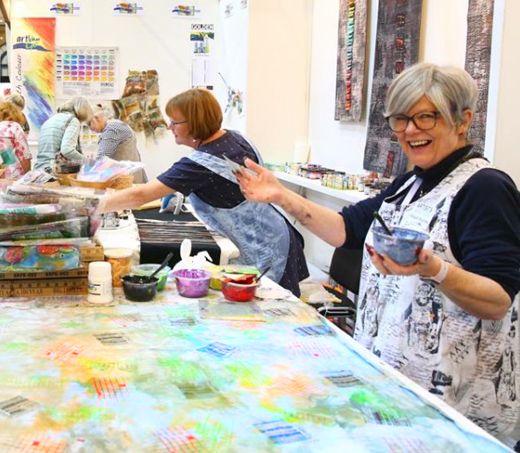
  • Lay the fabric onto a plastic sheet and paint as desired with one or several colours. Colours will run and flood into each other more on a wet surface than a dry surface.
  • When painting is complete, wrap the fabric up in the plastic and leave for several hours -
    overnight, 24 or 48 hours (basically as long as patience will allow) - somewhere that is not stone cold. The UREA and the plastic sheet keeps it damp and the longer it remains damp the better the dye uptake.
  • When ready, unwrap and then rinse as for dye-bath.
  • To obtain even more striking colours, try soaking the fabric in a washing soda solution before painting.
    Heat can be applied to speed up the curing/fixing period. Let fabric air dry. Iron on hot setting for 10mins or tumble dry for 1hr. Alternatively, heat in a reliable warm oven.

To make up as a thick paint or paste for printing or painting

Option 1:
Sprinkle 9tsps MANUTEX powder or 4.5tsps SODIUM ALGINATE powder over the 1Litre Chemical Water. Whisk until smooth. Let stand for one hour then stir. Leave in fridge overnight. Once made up the thickened chemical water will keep for one month if stored in a cool,dark place. Add to the dye powder in the palette with the WASHING SODA WATER as for the above recipe.

Option 2:
Make up the dye solution in the palette as for FREE FLOWING COLOUR.
Add SUPERCLEAR to the solution. Superclear is a thickener that is available in a jar ready to add when you want it. It can be added in proportions as desired - a little to reduce the flow of the colour, more to stop the flow as for block-printing.

In either case, treat the completed fabric as for FREE FLOWING COLOUR to fix the colour.

Experiment with mixing and blending colours. Dye and over-dye fabric. Use brushes, sponges or foam brushes to apply colour. Drop colour onto fabric using nozzle-bottles, pipettes and syringes. Paint or drop over tied or wax-resisted fabric. Use print-blocks with thickened dye.

Procion dyes and dyeing auxiliaries are in the Fabric Art section of our catalogue, on pages 28 - 29: take me to the catalogue download page...

Copyright © Art Van Go 2000-2006


  home | shop | gallery | workshops | techniques | out & about |  about us